As the title says I've not been up to much lately. Just working, working and working some more!
I did manage to get a session down at MCC last week, the first one in a long time, and I was pleasantly surprised. I was probably climbing about the same grade (bouldering) as I was 6 months ago. Flashed most of the problems in the V2-V4 range and even manged to flash a few from from the V4-V6 problems. It was a nice surprise and certainly not expected. One thing it highlights is that my training, probably more specifically my diet, really wasn't helping with my climbing, but I've spoken about that. As the weather is utter rubbish at the moment climbing really isn't on the cards, outdoor at least. I might head down to rockover this week and see what's what. Although my fingers might be weak(er) overall I feel fair bit strong (or more stable at least) so it would be interesting to see. Might see if I can't get a routing session in at the weekend and check my stamina. I expect my route fitness is non existent!
The gym has been off the cards as I currently am without transport. The car is playing up (electrical fault of some description) and the bike I was using is out of action. It wasn't my bike and I had it on long term lone from Andy, which I very much appreciate!! He's asked for it back so I've stopped using it and plan on giving it a full service so it's in tip top condition when he gets it back. I'm waiting on some parts and tools to turn up and then I can get it done.
This left me with a minor dilemma; what do I do about transport? Well I've always had a bike since the ripe old rage of 11 when I had my first BMX. There was a small part of me that wanted a BMX again but they are less than practical!
I've got an old mountain bike frame which would make a good starting point for a single speed cruiser, so that's what I plan on doing. Once these tools turn up it can be stripped and the various parts that need adding/replacing can go on and it should be good to go!
This will be the bare minimum to get it road going but I plan to slowly build it up etc. I've added a page to blog which will detail the various stages and should hopefully serve as a guide to anyone who wants to do the same thing.
Showing posts with label sport climbing. Show all posts
Showing posts with label sport climbing. Show all posts
Wednesday, 15 May 2013

Wednesday, 25 April 2012
El Chorro
So after almost 2 weeks of no posting, I'm back from El Chorro. I extended the stay by an extra 6 days to get more climbing done. I could have happily stayed for longer but with work looming in the back of my mind I knew that was about as much as I could get away with!
As it was a fairly long trip I'm just going to pick out a few highlights and some of the positives from the trip. It's all a little mixed up in my mind as to what day we did what so I'll just write it as it makes sense in my mind.
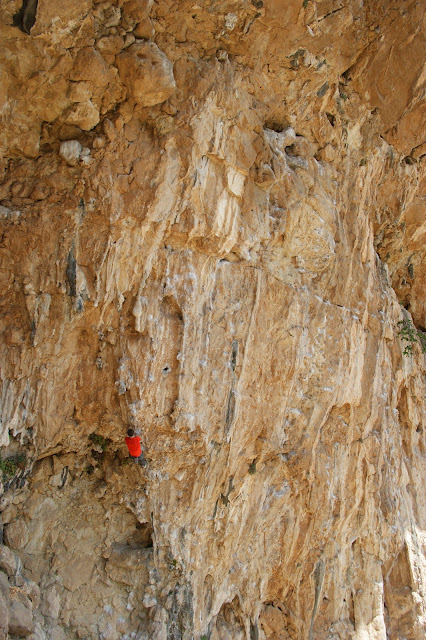
Firstly was the bunk-house which we managed to get in was pretty awesome. The Olive Branch is a little B&B which has both a bunk house and camping facilities. It's Run by Gary and Mel and they are really friendly and very helpful. If you going out there then certainly give this place a look. I know I'll be staying there again! The other positive about this place is there is a crag right behind it. Las Encantatdas hosts a number of climbs (36 in the Rockfax guide) with most being in the 6b to 7b category with a few 8a and above routes. It's a great place to go in it's own right with a couple of quality 7a's. I ticked a really good 6c+ called La ley del Cateto. An easy lower section leads to a blank looking groove which you bridge up. After this a few fierce pulls on smaller slots and side pulls lead to a jug and the anchors. It took me about 5 goes to get it but it packs a lot of climbing in it's 24 metres.




As it was a fairly long trip I'm just going to pick out a few highlights and some of the positives from the trip. It's all a little mixed up in my mind as to what day we did what so I'll just write it as it makes sense in my mind.
Firstly was the bunk-house which we managed to get in was pretty awesome. The Olive Branch is a little B&B which has both a bunk house and camping facilities. It's Run by Gary and Mel and they are really friendly and very helpful. If you going out there then certainly give this place a look. I know I'll be staying there again! The other positive about this place is there is a crag right behind it. Las Encantatdas hosts a number of climbs (36 in the Rockfax guide) with most being in the 6b to 7b category with a few 8a and above routes. It's a great place to go in it's own right with a couple of quality 7a's. I ticked a really good 6c+ called La ley del Cateto. An easy lower section leads to a blank looking groove which you bridge up. After this a few fierce pulls on smaller slots and side pulls lead to a jug and the anchors. It took me about 5 goes to get it but it packs a lot of climbing in it's 24 metres.

Chilling out before the upper crux section and after the smearing groove.
We also got on a great 7a up there called Redders. A tricky lower section leads to some jug pulling and a fantastic no hands rest in a grotty cave (complete with copious amounts of swallow poo!). From there some odd moves involving jamming and general thrutching lead to the anchors. Although the climbing wasn't too difficult from the cave, the bolt was a long way out right and good swing was going to be had should a fall be taken. I can confirm that the swing certainly is good! I fell coming out of the cave and with the anchors in sight. Do be warned though, if you attempt this route late in the evening swallows nest in the pockets of route. A number came out at a fast pace straight towards Joe's face on his go. This meant him checking each hold as he went along with tapping the rock and making a 'kakaa' sound!

Joe pulling through the middle, juggy, section of Redders - watch out for the swallows mate.

Me taking the huge rest in the swallow poo cave of Redders, 7a, at Las Encantadas.
We also headed over to the Poem Cave to have a look at one of the classic 7a's, Poema de Roca. Described as a fun, and pumpy romp up up steep tufas and cracks it was certainly steep and good fun. I'm a big advocate of onsight climbing climbing as I think it is climbing in it's purest form. That being said, trying to onsight a classic route like this can be difficult. So many people get on it there are chalked up holds everywhere. This results in you making about 5 moves to find the best hold which can really pump you out. After a warm up on a good 5+ and a 6b called Stonker we headed over. After waiting in a cue for a couple of hours we decided to go elsewhere and come back another day. On our return the following week we had the line to ourselves. Ste put the draws in and I cruised my way to the rather odd head rest. Not feeling too pumped I pushed on only for the pump to set in just as I was making the clip. I reversed and tried to recover at the rest but it wasn't enough and I was off. This was certainly a theme of my trip, getting close to ticking alot of 7a's but not actually ticking one, more on this later. We went back for a 3rd day but I still couldn't manage it. Ste cruised it on his 2nd redpoint and Joe got the flash: Good work boys!

Ste on his redpoint of Poema Da Roca, 7a.

The traverse right into the cracks and another good jug to rest on, just didn't have it in me to make the moves.

The no hands head rest, it's better when you face the other way!
Once the decision had been made to go to El Chorro I had to get a guide book (I'm one of those people who trawls guide books until I know the routes pretty well - it get's me psyched for a trip!). There a were a few multi-pitch sport climbs to be had and the classic has got to be Amptrax. At 6a the climbing isn't hard but you cartainly get some great exposure, the route being 140m long and having a 45m traverse in it. Myself and Joe decided we'd give it a shot. In our intial excitement to do it, and after going slightly crazy on our rest day, we had banded the idea of simu-climbing it (i.e both climbing at the same time but still with a rope attached between us). Our better judgement took over on the day and we decided to climb it the old fashioned way and alternate leads. We'd also had a chat with some people from Edinburgh University climbing club and two of their group would be doing it the same day. The race was on, we got up early and picked up the pace to ensure we were first on route, and we were. After a near miss scrambling to the bottom of the route, Joe pulling a hold off and nearly falling off, we got geared up and started.

Amptrax. The line in black shows the 7 pitches which me and Joe climbed and the red line is the abseil we made to get back to ground.
Linking the first two pitches together, 3 and 5+, we were well on our way. Joe lead the next short 5+ pitch and we were going to swing leads from here. At this point we noticed that the pair from the University club had started climbing. Not wanting to be caught up we decided to start linking the pitches again. This meant I got to lead the two 6a pitches. It's some of the most fun and enjoyable climbing I have done; nothing particularly hard but interesting all the way.

Belaying at the top of the two 6a pitches on Amptrax. Joe is 36m below at the last belay.
This left Joe with the two traverse pitches which again we linked together. Again these involved some great climbing and some fantastic exposure.

Joe off round round the corner on the traverse pitch.
The route can be finished with an easy, but possibly loose, scramble or 4 35m abseils. We opted for the abseils, but with Joe's slightly shortened rope we weren't sure if we could make it to all the abseil points. This turned out to be case on the first abseil, the result of which was me hanging on a single bolt while Joe abseiled to another lower-off in order to get to the next abseil point - scary times. I told myself it was ok though as the bolt looked pretty new! We eventually got down and headed to find Danny and Ben. I can certainly recommend Amptrax especially if it's with-in your onsight grade! Also bolted belays make a nice change to trad belays. With-in about 2 mins of getting to the belay you can have it set-up and have your partner really to climb. It probably only took us about 2 and 1/2 hours from top to bottom, with 45 mins being spent on getting down.
The rest of the time was spent trying some of the 7a, 7a+ and 7b routes. Unfortunately I didn't tick any them (my goal was to try and tick 5 7a's!) but I feel like I've really improved while out there. It can be hard, and pretty disheartening, to keep falling off stuff and not getting to the chains. But it was good to be on stuff that is testing me all the time. My psyche stayed pretty high throughout and I was always keen to get on another route even if it I didn't get it clean.
By using the mental strategies which I've spoken about it was easier to take positives from my climbing. I think the thing which is spurring me on more now is the thought that I was continually getting close to ticking 7a's and b's. 6 month's ago I thought 6a's and b's were about as good as I was ever going to get and my hardest redpoint was 6b, which I did over a year ago. Since I've started writing this blog I've ticked a few 6c's, a 6c+ and a 7a; things are certainly moving in the right direction!
I'm already planning my trip back there in October and with one clear goal in mind: Lourdes, a classic 8a at Makinodromo - an unrelenting pitch up the central line of tufas that sports a hard start and a pulse-enhancing finish... When I go back I also want to flash all the routes which I have been unable to do on this trip. Although 8a may appear a rather stratospheric target to some, I certainly feel that if I carry on with my training, get out as much as possible and continue keep pushing myself that 8a is most definitely on the cards!
The other interesting point to make note of is rest! I climbed for 12 days with 1 days rest. I felt pretty battered but I was surprised with how well my body coped with it all. I think it is finally starting to get used to the level of intensity which is required to climb harder routes (it's only taken about 7 years!).
Rests were also much more common on the routes in El Chorro. This is something which I wasn't used to and it took a while for me to make the most of them (I still don't think I took full advantage of them!). You don't experience them so much on British routes, or the ones I have climbed at least, as they tend to be short. Most pitches we climbed were 30m in length so many had some form of decent rest or, hard overhanging sections were interspersed with easier climbing where you could get really good shakeouts. I think this will really help on the mountain trad routes which I want to start climbing, which tend to have more cruxy sections followed by easier sections.
The trip as a whole was absolutely class and I'm not sure I've laughed as much in a very long time. We met some really cool people as well and it was great to hear about their experiences, of both El Chorro and other climbing areas. It has certainly made me feel a lot more positive about my climbing and I know that I can achieve what I want to with my climbing. I keen to see what how my fitness has improved, steep walk-ins and climbing for 12 days should certainly of helped that's for sure! I could be pretty downbeat about not getting a 7a (there were a few which I could have ticked but weren't worth it other than to say I had ticked a 7a) but I'm keeping the positives in mind. The two points which I keep in mind are that I had fun and it was independent of ticking a 7a. Secondly that I'm plenty powerful enough to tick 7a and 7b but I'm not making the best use of that power through poor technique.
Oh and the final point is that Prince's are the best biscuit in the world, but we improved them by spreading them with copious amounts of nutella! A big thanks to the boys; Joe, Ben, Danny and Ste! Just remember folks - Maka da chalk, maka da move, maka da clip and you maka da climb!

Monday, 19 March 2012
Climbing Explained
A little bit of side note for those reading this blog who aren't climbers, I've realised that I'm using a fair few technical terms and describing things from a climbers viewpoint so it might not make much sense - sorry about that! The idea of the blog is to give both climbers and non-climbers an idea of what it takes to improve in climbing, what it feels like to succeed and fail, and how you move on from these points. Although all these ideas are wrapped up in a climbing framework I know they can be applied to any aspect of our lives and will give some success!
So before I go any further a few things I should probably explain.
Trad (traditional climbing): This type of climbing involves at least two climbers - leader and second. The leader will be the climber who attempts to climb the route/pitch first, the second will belay the leader (feed rope out, hold a fall, shout encouragement, moan that it's taking the leader too long and they are getting cold,...) then follow after the leader has got to the top. In order to make the climb safe, the leader has to place protection (bits of metal generally) into the rock, using the natural shape and features (such as cracks) of the rock. Should the leader then fall at any point, the last piece of protection will protect him against falling to ground (hopefully). Once the leader has got to the top of the climb, the second will come up the route (the leader now belays the second), taking out the protection.The second is protected by virtue of having a rope above them. This process can then be repeated numerous times to finish a climb. The length between two belays is known as a pitch and repeating this process many times up a wall or face is known as a multi-pitch.
The routes are then graded based on the following: the amount of protection, how good that protection is (likely hood of holding a fall or stopping you hitting the floor) and the difficultly of the hardest move/set of moves. The grades have two parts in British trad climbing. The adjectival grade (overall danger of the climb) and the technical grade (difficulty of the hardest move, or sequence of moves without consideration of the danger or the stamina needed if there are several such sequences in a row).
The technical grades are open ended but generally only start at 3c/4a. These go 3c, 4a, 4b, 4c, 5a,.....7b.
The adjectival grades are:
- Easy (rarely used)
- Moderate (M, or "Mod")
- Difficult (D, or "Diff")
- Hard Difficult (HD, or "Hard Diff" - sometimes omitted)
- Very Difficult (VD, or "V Diff")
- Hard Very Difficult (HVD, or "Hard V Diff" - sometimes omitted)
- Mild Severe (MS)
- Severe (S)
- Hard Severe (HS)
- Mild Very Severe (MVS)
- Very Severe (VS)
- Hard Very Severe (HVS)
- Extremely Severe (E1, E2, E3, ...E11)
Sport climbing: In this type of rock climbing the climber is not required to place protection. The protection comes in the form of large expansion bolts, or ring bolts, which the climber places a quickdraw in. Although this type of climbing is seen as 'safe' there are still some dangers, but these are greatly reduced when compared to trad. Sport climbs in the UK are graded using the French grading system. This grade, often prefixed with the letter F, gives the overall technical difficulty and strenuousness of a particular route. The grading system starts at 1 and currently goes up to 9b+. Most climbs in in the UK start around 4 and continue as such: 4+, 5, 5+, 6a, 6a+, 6b....8c+/9a.
There are numerous grading systems for other climbing areas around the world and other aspects of climbing (e.g bouldering, big wall or aid). Some idea of how they compare can be taken from the Rock Fax guide

Trad vs Sport. Trad climbing is very demanding mentally, it requires a calm approach in order to rationalise the danger that the climber is faced with. Usually the climber knows that small sections of the climb will be hard (crux sections) but will be interspersed with easier sections having larger holds (jugs) where some form of rest can be gained. Sport climbing on the other hand is very physical, routes tend not to have so many easy sections and are physically demanding from the bottom to the top. The mental aspect comes from staying focused on a redpoint attempt and not get frustrated if you fail or cannot work out a sequence (easier said than done).
The grades given to a trad climb are for the onsight style of ascent. There are varying styles of ascent for any given climb these are:
Onsight: climber has no prior knowledge of the climb other than the guidebook description (gives a description of the climb and the grade of the climb) and what can be seen from the bottom.
Ground up: A climber attempts the onsight but fails. They return to the ground and pull the rope through (so they are no longer protected by their previous highest point of protection). They then start again, reclipping any protection.
Flash/Beta-flash: If a climber has prior knowledge of the route (Beata: moves, sequence, protection) and then climbs the route. This information may be due to seeing someone else climb the route or having been given beta about the route, but not having themselves climbed the route before.
Redpoint: In sport climbing a climber may work a route with aid of top rope (see the image below). This allows the climber to practice the moves and sequence of the route until they know them very well. Once the sequence of moves has been determined and memorised, they will attempt the route from the ground clipping in the quickdraws as they go without the aid of a top rope.

Here we see a climber climbing a route using a top rope. The rope is attached to the top of the climbing, using a carabiner, and the climber attaches themselves to the one end. The other end is attached to a belayer. They then use a 'belay device' to pull the rope through the attachment point at the top of the climb. This allows the climber to practice without the risk of falling very far.
Head-pointing: a mix of trad climbing and sport climbing techniques. The climber will work (practice) the moves on a trad climb in order to determine the sequence of moves. Once all the moves have been practiced and done in one consecutive go from the bottom (linked), then the climber attempts to climb the route without the aid of a top rope. Climbers may wish to place protection either before leading the route with the aid of top rope, or place the protection whilst on the lead.


The protection for sport routes is shown below. The climber places the quick draw through the bolt, these have been drilled in to the wall and glued in, and then clips the rope through the quickdraw.

Hopefully that will clear up some of the technical stuff I talk about. I'll try and add some more posts about various aspects of climbing, training techniques, and the hold types which I talk about along with pictures or videos. They do say a picture paints a thousand words! I'll also add a post about belaying as this is an important part of any climbing team.
Subscribe to:
Posts (Atom)